
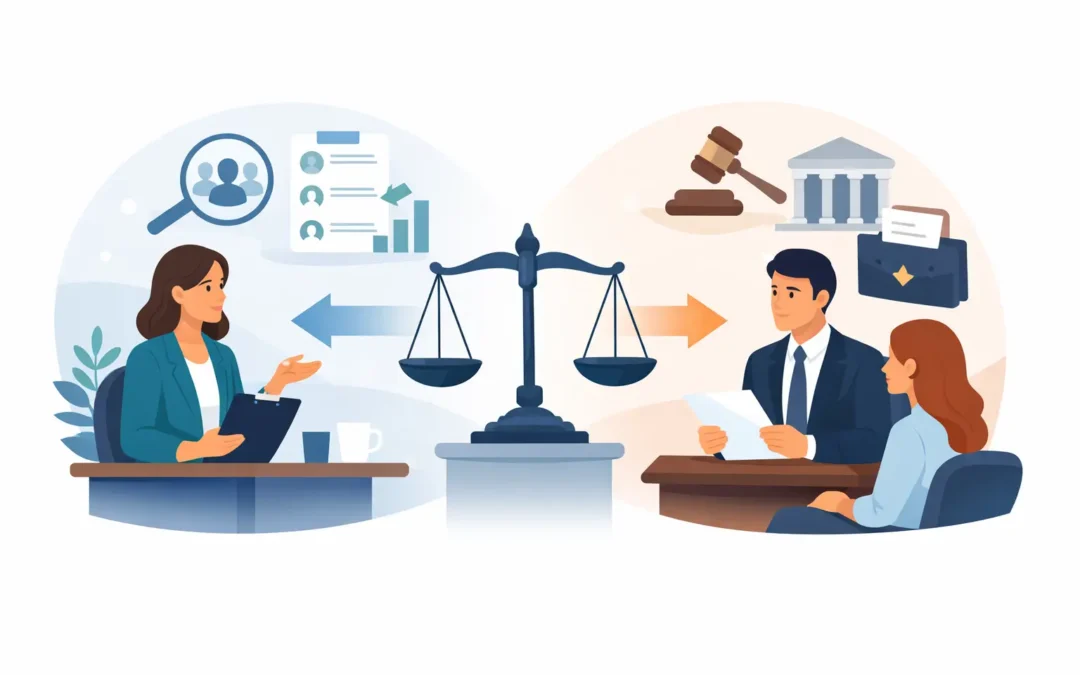
A manager tells you a staff member has made a bullying complaint. Or you discover an employee may have been underpaid under an award. Or a termination has become contentious. In moments like these, the question is rarely whether you need help. It is whether to call an HR consultant vs employment lawyer first.
For Australian SMEs, the right answer depends on what has happened, how urgent the risk is, and what outcome you need. An HR consultant helps you manage people issues properly before they escalate. An employment lawyer provides legal advice when a dispute, claim or high-risk legal question demands it. The most commercially sensible approach is often knowing where one role ends and the other begins.
HR consultant vs employment lawyer: the practical difference
An HR consultant is focused on the employment relationship in practice. That means helping your business make sound, fair and compliant decisions about people, while keeping operations moving. They work with managers on the everyday issues that, if handled poorly, can later become expensive disputes.
This may include reviewing employment contracts, interpreting modern awards, developing policies, managing performance concerns, responding to misconduct allegations, conducting workplace investigations, advising on restructures, and supporting a fair termination process. Good HR advice considers Fair Work obligations, but it also considers the human and operational reality of your workplace.
An employment lawyer is focused on the legal position, legal risk and legal remedies. They can provide formal legal advice, represent your business in proceedings, prepare legal correspondence, negotiate settlements and advise on complex legislation or contractual disputes. Their role becomes particularly valuable when a matter has moved beyond internal management and into a legal claim, threatened litigation or a dispute where legal strategy is required.
Neither option is inherently better. They solve different problems. The mistake is treating a serious employee issue as purely legal when practical HR management could resolve it early, or treating a legal dispute as an ordinary HR matter after the stakes have risen.
When an HR consultant is usually the right first call
Most SME people issues do not start in a courtroom or before the Fair Work Commission. They start with a manager who is unsure what to say, an employee whose performance has slipped, a complaint that has not been documented, or a business that needs to change roles due to operational pressures.
An HR consultant is usually the best first call when you need to manage the issue correctly from the outset. They can give your manager a clear process, prepare the right documents, help you have difficult conversations and keep a factual record of what occurred. This is where practical experience matters. A technically correct letter is not enough if the manager then handles the meeting badly or skips a critical step.
For example, if an employee is consistently missing targets, an HR consultant can help determine whether this is a performance, conduct, capability, training or personal issue. They can then develop a realistic performance improvement plan, coach the manager on the conversation, set review dates and ensure the process is fair. That gives the employee a genuine opportunity to improve while protecting the business if further action is needed.
The same applies to common workplace needs such as:
- reviewing whether pay rates and classifications align with the relevant award;
- preparing employment contracts, policies and position descriptions;
- managing probation reviews, flexible work requests and leave concerns;
- investigating workplace complaints or interpersonal conflict;
- supporting a redundancy or organisational change process; and
- building manager capability so issues are addressed earlier and more consistently.
For growing businesses, outsourced HR support can also prevent a pattern of reactive decision-making. Rather than calling for help only when a resignation, complaint or claim lands, you can put compliant foundations in place and access senior guidance when a sensitive matter arises.
Where an employment lawyer is the better choice
There are times when your business needs formal legal advice, not just good HR process. If you have received a letter of demand, a Fair Work Commission application, a discrimination complaint, a subpoena, or notification that an employee has engaged legal representation, speak with an employment lawyer promptly.
A lawyer is also the appropriate adviser for complex questions involving restraint of trade clauses, senior executive disputes, business sales, shareholder-employee conflict, enterprise agreements, significant underpayment exposure or allegations that could result in litigation. These matters can turn on detailed legal interpretation and may require advice that is covered by legal professional privilege.
Legal professional privilege is an important distinction. Communications with an employment lawyer that are made for the purpose of receiving legal advice may be protected from disclosure in certain circumstances. Discussions with an HR consultant are generally not protected in the same way. If you are anticipating a claim or need advice on your legal position, this can be a deciding factor.
That does not mean HR should step away completely. In many disputes, the lawyer manages legal strategy while an HR consultant helps gather the employment history, organise documents, prepare managers, address ongoing team issues and implement any agreed outcome. The two roles can work alongside each other effectively when responsibilities are clear.
The cost question: look beyond the hourly rate
Business owners understandably compare fees. Employment lawyers typically charge higher hourly rates than HR consultants, particularly for specialist workplace relations advice and litigation. But the real cost is not simply the invoice. It is the cost of using the wrong support at the wrong time.
Calling a lawyer to draft every routine performance letter may be unnecessary and expensive. On the other hand, proceeding with a high-risk dismissal without legal advice because you want to keep costs down can create far greater exposure if the employee makes an unfair dismissal, general protections or discrimination claim.
An HR consultant can often manage the practical process at a more predictable cost, identify where legal input is genuinely needed and reduce the amount of legal work required later. For an SME without an in-house HR team, this provides useful commercial control: senior HR guidance for day-to-day decisions, with legal escalation when the facts require it.
A simple way to decide who to call
Start by asking what you need right now. If you need help managing an employee, running a fair process, interpreting an award, documenting a decision or guiding a manager through a sensitive conversation, start with HR. If you need to defend or pursue a legal position, respond to a formal claim, negotiate a settlement or obtain advice on complex legal exposure, call an employment lawyer.
The timing matters as much as the issue. Early HR involvement can stop a manageable concern becoming a formal dispute. For instance, a poorly handled performance conversation can later be characterised as adverse action or discrimination. A rushed redundancy can create uncertainty about consultation and redeployment. An incomplete investigation can undermine confidence in the outcome. These are not reasons to avoid action. They are reasons to take action with a clear process.
Do not wait until the decision has been made
One of the most common calls HR advisers receive is from a manager who has already told an employee they are being dismissed, made redundant or moved into another role. At that point, options may be limited. The wording used, the reasons given and the absence of consultation can all affect the risk profile.
Bring in support before communicating a major employment decision. A short discussion at the planning stage can clarify the relevant award or contract, identify procedural requirements, test whether the proposed approach is defensible and prepare the manager for the conversation. It is usually faster, less stressful and less costly than trying to repair an avoidable error afterwards.
For many businesses, The HR Department Consulting Group is the practical first point of contact for this type of support. We help leaders assess the facts, put a workable process around the issue and identify when specialist legal advice should be obtained.
The best time to seek guidance is when you still have choices. A calm, well-documented and fair approach gives your business the strongest footing – and gives your people the clarity they deserve.