
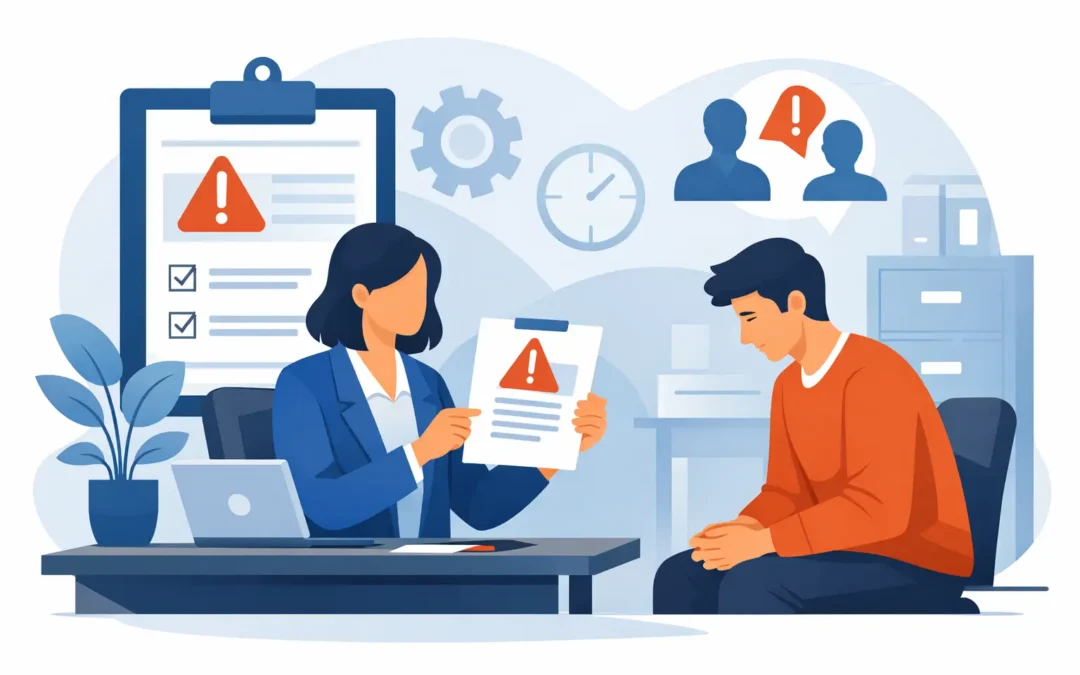
A warning letter is not a formality to send after an awkward conversation. It is a record of what happened, how the employee was given a chance to respond, what must change and what may happen if it does not. The best employee warning letter templates help Australian SME managers document that process clearly, but only when the template reflects the facts and follows a fair process.
A poorly handled warning can create a bigger problem than the original conduct issue. It may be vague, inconsistent with prior treatment of other staff, unsupported by evidence or issued before the employee has had a meaningful opportunity to respond. A well-written letter, by contrast, protects the business while giving the employee a genuine and practical pathway to improve.
What makes an employee warning letter effective?
The strongest warning letters are specific, proportionate and written after the relevant facts have been checked. They do not rely on labels such as “bad attitude”, “poor performance” or “unprofessional behaviour” without explaining what the employee did or failed to do.
For example, rather than saying an employee has been unreliable, identify the dates they arrived late, any contact they did or did not make, the impact on the roster or customers, and the employee’s explanation. This gives the employee something they can properly respond to and something they can reasonably be expected to improve.
An effective letter should record the allegation or concern, the meeting date and attendees, the employee’s response, the findings reached, the required improvement, the review period and the potential consequences of further issues. It should also state any support being offered, such as refresher training, clearer procedures, more frequent check-ins or a reasonable adjustment where appropriate.
The language should be firm without being emotional. A warning letter is not the place to vent frustration or build a case through exaggeration. Assume the document may later be read by the Fair Work Commission, a lawyer or an external investigator. Keep it factual, respectful and easy to follow.
Best employee warning letter templates for common situations
There is no single letter that suits every workplace issue. A first warning for repeated lateness is different from a final warning for a serious safety breach, and both are different again from a performance warning. Use the right structure, then tailor the wording to the employee, the evidence and your workplace policies.
Template 1: First written warning for misconduct
Use this where an employee has breached a reasonable workplace standard, but the conduct does not justify immediate termination. Common examples include repeated lateness, failing to follow a reasonable direction, inappropriate workplace communication or unauthorised absences.
Subject: First Written Warning
Dear [Employee name],
This letter confirms the outcome of the meeting held on [date], attended by [names]. We met to discuss concerns regarding [describe conduct clearly, including relevant dates, times and details].
During the meeting, you explained that [summarise the employee’s response accurately]. Having considered the available information and your response, we have found that [state the finding]. This conduct does not meet the standards expected under [relevant policy, procedure, contract term or reasonable direction].
You are required to [state the expected conduct]. This improvement must be immediate and ongoing. We will review your conduct on or around [date].
This letter is a first written warning. Further conduct of this nature, or failure to meet the required standard, may result in further disciplinary action, up to and including termination of your employment.
If you require clarification or support to meet these expectations, please speak with [manager name].
Yours sincerely,
[Name and position]
This template works because it records a finding after the employee’s explanation has been considered. Do not issue it as a pre-written outcome before the meeting. If new information emerges, investigate it before deciding what action is appropriate.
Template 2: Performance improvement warning
Performance concerns require more detail than most conduct warnings. The employee needs to understand the standard, how their performance falls short and what measurable improvement looks like. A vague instruction to “work harder” is not enough.
Subject: Written Warning and Performance Improvement Requirements
Dear [Employee name],
Following our meeting on [date], this letter confirms the concerns discussed about your performance in the role of [position]. The concerns are: [set out specific examples, results, quality standards, deadlines or customer issues].
You advised that [summarise the response and any contributing circumstances]. We have considered this information. The required standard for your role is [describe the reasonable standard], and your performance is currently not meeting that standard.
Effective immediately, you are required to achieve the following: [set out clear measures, targets or behaviours]. Your performance will be reviewed at [weekly or fortnightly] meetings, with a formal review on [date].
The business will provide the following support: [training, coaching, tools, adjusted priorities or other appropriate support]. You are expected to raise any barrier to meeting these requirements as soon as it arises.
This letter is a written warning. If the required improvement is not achieved and sustained, further action may be taken, including termination of employment.
Yours sincerely,
[Name and position]
A performance warning should not set impossible targets or ignore genuine resourcing problems. If expectations have changed because the business has grown, systems have failed or the role has expanded, address those issues as well. Performance management is strongest when the standard is reasonable, communicated and supported.
Template 3: Final written warning
A final written warning is serious. It may be appropriate where there has been prior relevant conduct, a significant breach of policy or a failure to improve after clear support and direction. It should not be used simply because a manager has run out of patience.
Subject: Final Written Warning
Dear [Employee name],
This letter confirms the outcome of the meeting held on [date] concerning [describe the conduct or performance concern]. You were provided with an opportunity to respond and stated that [summarise response].
After considering the information available, including [relevant evidence or previous warning dated], we have determined that [state finding]. This is a serious matter because [briefly explain the workplace, customer, safety, financial or team impact].
You are required to [state the required improvement or conduct] from today. This will be reviewed on [date], or earlier if further concerns arise.
This is a final written warning. Any further breach of this requirement, or failure to demonstrate immediate and sustained improvement, may lead to termination of your employment.
Yours sincerely,
[Name and position]
Before issuing a final warning, check the employee’s history, the currency of any previous warnings and whether the earlier warning addressed genuinely similar concerns. A final warning is not automatically fair just because one has been issued before.
The process matters as much as the letter
A template cannot repair an unfair process. Before issuing a warning, identify the concern and gather the relevant evidence. Invite the employee to a meeting, explain the issue in enough detail for them to prepare, and allow them to bring a support person if they request one. At the meeting, listen to their response with an open mind.
The right outcome may be no warning at all. The facts may not be substantiated, another employee may be responsible, the worker may have a valid explanation, or a health issue may need to be managed differently. If an employee raises a medical condition, pregnancy, family and domestic violence, discrimination concern or other protected issue, pause before acting. The legal and practical risks can change quickly.
For serious misconduct, do not assume the answer is an immediate dismissal or a final warning. The nature of the allegation, the evidence, the employee’s explanation, the workplace policy and the risk to the business all matter. A proper investigation and procedural fairness remain essential, even where the alleged conduct appears serious.
Avoid these common warning letter mistakes
The most common error is using a generic letter that contains no real detail. The next is treating the warning meeting as a decision already made. Managers also create risk when they refer to policies employees were never given, rely on hearsay without testing it, or promise consequences they are not prepared to apply consistently.
Be careful with wording that says an employee “admits” an allegation unless they actually did. Record their explanation fairly, even where you do not accept it. Ask the employee to sign an acknowledgement of receipt, not an acknowledgement that they agree with the warning. If they decline to sign, note that the letter was provided and how it was delivered.
Keep a copy of the final letter, meeting notes and supporting material in a secure personnel file. Access should be limited to those who genuinely need it. Privacy and consistency are both important to employee trust and to managing business risk.
When to get HR advice before issuing a warning
Seek tailored advice where the employee has a protected attribute or has recently exercised a workplace right, such as making a complaint, asking about pay or taking leave. The same applies where dismissal is being considered, the allegation involves bullying, harassment, discrimination, theft, safety, drugs or alcohol, or there is a dispute about what occurred.
The HR Department Consulting Group supports Australian SMEs with the practical work behind the letter: assessing the facts, planning the meeting, drafting appropriate documentation and helping managers take a fair, commercially sensible next step.
A good warning letter should leave no doubt about the issue, but it should also leave room for the employee to succeed. That balance is what turns documentation from a box-ticking exercise into a useful management tool.