
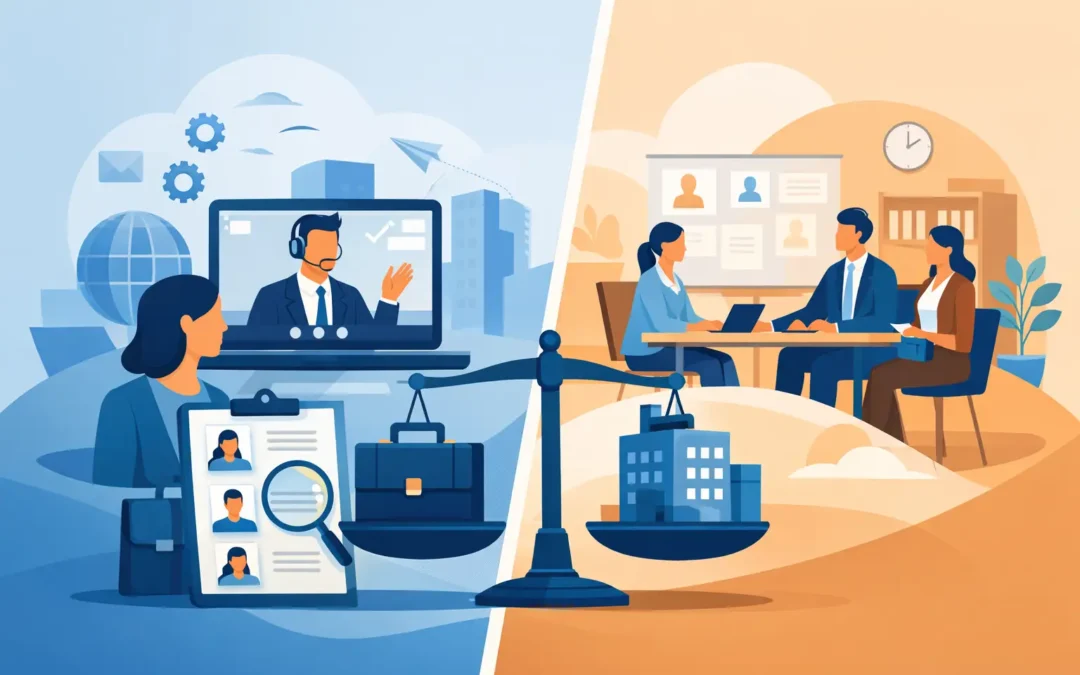
If you are weighing up outsourced hr vs in house, you are probably already feeling the pressure points. A staff issue has landed on your desk, a manager needs help with performance, or you are wondering whether your contracts, policies and pay practices would stand up to scrutiny. For many Australian SMEs, the real question is not whether HR matters. It is how to get the right level of support without taking on unnecessary cost or risk.
This is where the decision becomes practical very quickly. An in-house HR hire can bring day-to-day visibility and internal ownership. Outsourced HR can give you senior expertise, faster access to specialist knowledge, and a more flexible cost base. The best option depends on your size, growth stage, complexity, and how often people issues arise.
Outsourced HR vs in house: what is the difference?
In-house HR means employing someone internally to manage your people function. That might be a standalone HR manager, a coordinator, or a broader internal team depending on the size of the business. They are on your payroll, embedded in your operations, and available as part of the business each day.
Outsourced HR means engaging an external HR partner to provide support as needed or on an ongoing basis. That support can cover compliance, contracts, award interpretation, employee relations, investigations, performance management, terminations, policy development, change processes, and strategic advice. In practice, many SMEs use outsourced HR as an extension of leadership rather than a distant service provider.
The difference is not just who employs the HR resource. It is also about how much expertise you need, how often you need it, and whether you need breadth, depth, or both.
Cost is usually the first issue, but not the only one
For most SME leaders, budget starts the conversation. A full-time in-house HR employee comes with salary, superannuation, leave entitlements, recruitment costs, software, training, and management overhead. If the role is senior enough to handle complex employee relations and compliance matters confidently, the cost rises again.
That does not make in-house HR poor value. If your business has enough day-to-day HR volume to keep that person fully utilised, it can be a sound investment. But many businesses are not there yet. They need high-level advice during specific moments, not a full-time salary every week of the year.
Outsourced HR tends to suit businesses that want access to experienced support without carrying the fixed cost of a full internal function. You can scale support up when you are hiring quickly, managing a restructure, or dealing with a difficult employee matter. You can scale it down when things are stable. That flexibility matters when cash flow and headcount planning are tightly managed.
Compliance risk often tips the balance
Australian employment law is not forgiving of guesswork. Award coverage, minimum pay rates, casual conversion, termination process, consultation obligations, and record-keeping all carry risk. A lot of business owners do their best to manage this internally until something becomes contested. By then, the cost is rarely just financial. It affects time, morale, and leadership focus.
This is one area where outsourced HR can be particularly strong. A good external HR partner works across multiple businesses and sees recurring compliance problems before they escalate. They are often brought in specifically because a business needs clear advice, quickly, and with the legal and operational implications in mind.
An in-house HR person can absolutely manage compliance well too, but capability matters more than job title. A junior internal resource may be excellent administratively while still needing support on complex Fair Work issues, investigations, or high-risk terminations. In those cases, businesses can end up paying for internal HR while still needing outside expertise.
In-house HR offers proximity and internal context
There are good reasons some businesses prefer an internal HR hire. An in-house person sees the business up close. They understand personalities, reporting lines, workflow pressures, and the informal dynamics that shape employee behaviour. That proximity can help with manager coaching, employee engagement, recruitment coordination, and day-to-day consistency.
If your workforce is growing quickly or your managers need regular hands-on support, having someone in the business can improve follow-through. They can sit in on meetings, spot issues early, and build trust with staff over time.
That said, proximity can create its own complications. Internal HR can become stretched across admin, recruitment, payroll queries, and employee complaints, leaving little time for strategic work. In smaller businesses, they can also find themselves caught between leadership expectations and employee concerns, particularly if reporting lines are unclear or the role lacks senior authority.
Outsourced HR brings breadth and seniority
One of the main strengths of outsourced support is access to broader experience. External consultants typically deal with a wide range of industries, leadership teams, and workplace issues. That means they are often faster at identifying what matters, what can wait, and what needs immediate action.
For an SME, this can be more useful than simply having someone available on site. If you are handling an underperformance process, a bullying complaint, an award interpretation issue, or a planned termination, you often need calm, senior guidance rather than generalist administration.
This is why outsourced HR is not just a stopgap for businesses that cannot afford in-house support. It is often a deliberate commercial choice. You are paying for judgement, not just capacity.
Which model suits different stages of business?
The right answer usually changes as a business grows.
A smaller business with 10 to 30 employees often does not need a full-time HR hire. What it needs is reliable access to advice, compliant documents, and support when issues arise. In this stage, outsourced HR is usually the more efficient option.
A business with 30 to 80 employees may sit in the middle. There is more recruitment, more people management, and more risk exposure, but not always enough complexity for a complete internal HR function. This is where a blended model works well. You might have an office manager or operations lead handling day-to-day coordination, with outsourced HR providing senior oversight and specialist support.
Once a business reaches a larger scale, with frequent hiring, multiple managers, more formal structures, and regular employee relations activity, an in-house HR role can make stronger commercial sense. Even then, many businesses still keep external support for investigations, restructures, audits, or sensitive matters where independent advice is valuable.
Outsourced HR vs in house for Australian SMEs
For Australian SMEs, the outsourced hr vs in house decision is rarely ideological. It is operational. The better question is this: what level of HR support does your business genuinely need right now, and where are the real risks?
If your main needs are contracts, policies, Fair Work support, award interpretation, performance processes, and guidance through tricky employee matters, outsourced support can be the smarter fit. If your managers need daily coaching, your workforce is expanding fast, and HR work is happening constantly, an internal role may be justified.
The wrong decision is usually made when businesses hire too early, or too late. Hire in-house before there is enough work, and you create cost without full value. Wait too long to get expert support, and compliance or employee issues can become expensive distractions.
A blended model is often the most practical answer
This does not have to be an either-or decision. Many SMEs get the best results from combining internal ownership with external expertise. A business leader, operations manager, or internal coordinator handles the day-to-day rhythm of the workplace. An outsourced HR partner steps in for the matters that carry legal risk, require specialist judgement, or need an objective view.
That model gives you responsiveness without overcommitting on fixed cost. It also reduces the chance that a well-meaning but inexperienced internal staff member is left to manage serious employee issues alone.
For businesses that want practical support without building a full HR department, this is often the most commercially sensible path. It keeps advice accessible, decisions grounded, and risk better managed.
The HR Department Consulting Group works with exactly this kind of business challenge – helping SMEs get the right support for where they are now, while building stronger people practices for what comes next.
If you are still deciding, do not ask which model sounds more impressive. Ask which one gives your business clearer advice, better compliance, and the confidence to deal with people issues properly when they happen. That is usually where the right answer becomes obvious.